
- Make a written list of all rooms, cars and devices used for transfer talks before the window opens.
- TSCM checks look for hidden listening devices, cameras, trackers and spyware in rooms, cars and on devices.
- Watch for warning signs like unexplained changes in a room or recurring faults in phones or alarms.
- If you suspect a leak, stop sensitive conversations, tell security and keep the area clear until checked.
On this page
How do you stop anyone overhearing your transfer talks this January?
Protect every place and device your transfer talks pass through, and treat the January window as a short project. We plan the cover in three parts: a check of everything before the window opens, specialist cover while your biggest meetings run, and a second check of the room once the talks end.
Start with a written list of where your January talks will happen and which devices will carry them, because every check you book is set against it. Keep the list itself between the few people who run your club’s deals.
Where transfer talks can be overheard
Your list starts with the boardroom. UK NACE, the UK National Authority for Counter-Eavesdropping, highly recommends that you control any space where sensitive conversations take place. It gives a boardroom or a meeting room you use often as examples. In January, those are the rooms where your fees, wages and contract terms get agreed. Its where you want every word to stay private.
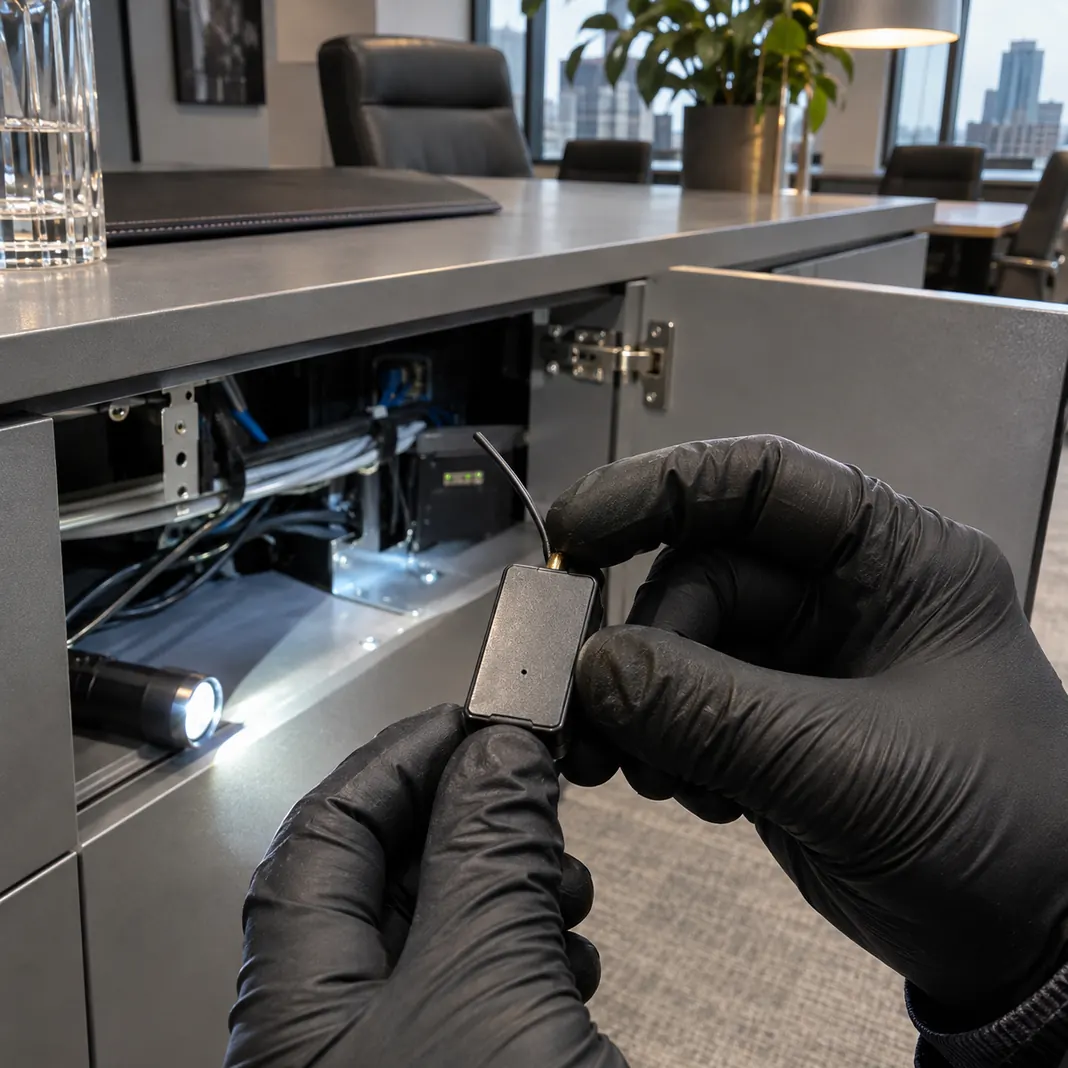
Checking those rooms is the job of TSCM, short for technical surveillance counter-measures. TSCM is a specialist check of your rooms, cars and devices for hidden listening devices, cameras, trackers and spyware. Spyware is software that secretly watches a phone or computer. Keyloggers, which record what someone types, are covered too, along with USB attack devices, which target a computer through its USB port.
Boardrooms, offices and cars
Fee and wage talks carry on in other rooms around the club. Add the chair’s and chief executive’s offices, the director of football’s office, and the recruitment and analysis rooms where the players you are chasing get discussed. Off-site venues and directors’ home offices belong on the list too, whenever talks move there or a director takes calls from home.
Any car that collects a player or an agent belongs on the list as well, because talk about the deal can start the moment the door closes. Our vehicle bug sweep checks those cars for hidden listening devices and trackers.
Keep an eye on what comes into the talks room, too. Surveillance devices can be bought freely online and hidden in everyday household objects, so give a new gift or gadget on the boardroom table a second look before an important meeting.
Phones, laptops and email
Your confidential transfer negotiations travel by email and phone as well as across a table. In a 2020 case reported by the National Cyber Security Centre, criminals stole the email login of a Premier League club’s managing director and watched his account. When they spotted a transfer agreed with a European club during the window, they posed as each club to the other and sent changed bank details. The scam failed only because their account carried a fraud marker, a warning flag against a suspect account. So the bank refused the payment, even though it had been approved.
So the phones, laptops and email accounts of everyone handling the terms belong on the same list as your rooms. We can check any Apple or Android phone and any Windows laptop. Our phone spyware check looks for hidden software watching a phone and we look at the accounts on each device too, including which other devices are linked to them.

Planning checks around the January window
Once your list is settled, plan your checks around the window dates. For the Premier League, the January transfer window opens on Friday 1 January 2027 and closes on Monday 1 February 2027. So get everything on your list checked before the first talks begin.
One thorough check at that point suits most of your list. Give closer cover to the few meetings where the biggest terms get agreed with agents or another club, which can come at any point up to deadline day.
| When | What it covers | Suited to |
|---|---|---|
| Before the window opens | The rooms, cars, phones and laptops used for talks | Every club with January business planned |
| During a key meeting | The meeting room while the talks run | Fee, wage and contract talks with agents or another club |
| After the talks | The meeting room once the talks end | Meetings where visitors have been in the room |
Here at National Bug Sweeping, we cover a key meeting from start to finish through our office bug sweep service. That cover includes a pre-meeting sweep, live meeting monitoring while the talks run and a check once they end. A check shows the state of a room on the day it is done. Surveillance threats keep changing, with new ones appearing all the time, so no check comes with a guarantee.
Your own staff can help by watching for new objects in the talks room. For anything professionally installed, UK NACE advises that you leave it to TSCM professionals. If a member of staff leaves during the window, add a check of the rooms and devices they used, as an insider leak is more likely in the time just after someone leaves.

What if you think a meeting room is bugged?
If an agent or another club seems to know terms that were only ever said in your meeting room, you can deal with it calmly, one step at a time. UK NACE lists that as one of three warning signs of technical surveillance, which means someone secretly listening or watching through hidden devices. Watch for the other two as well: an unexplained physical change in the room, and a recurring fault in an alarm, phone or IT system that nobody can explain or fix.
When you notice one of these signs, take these four first steps in order:
- Stop sensitive conversations in that room straight away.
- Tell your security team, without using the room or any of the devices you are worried about.
- Leave anything suspicious untouched.
- Keep sensitive talk out of the area until a technical security professional tells you it is safe.
Until then, do not discuss your concerns in that room at all, “even as a joke”, as the guidance puts it. If you suspect a leak during transfer talks, that is a good moment to have the room and the devices used in it checked.
Our work with football clubs
We already provide TSCM for a professional football club every month. We check its rooms before meetings, cover them while the talks run and check again once they end. Jack Charman, our lead expert, runs that work, and cover for a transfer window uses the same three stages.
A club in the public eye needs checks done quietly. We can sign an NDA, a written agreement to keep your club’s business confidential, and arrive in unmarked vehicles. Discreet invoicing is available too, and only trusted operatives carry out the work.
Once a check is done, every client gets a full TSCM report with our findings and advice. Anything we find can be bagged as evidence with a chain of custody record, which shows who has handled it at each stage. Live device finds are rare. Weak spots turn up on almost every sweep, and the report sets them out for you.
As for cost, our prices start from £600 + VAT. Your quote depends on location, the size of the job, the threat level and how urgent it is. Evenings and weekends carry no extra charge, so a check can fit around match days and late meetings.
The advice that comes with every report covers the gaps between physical, cyber, data and information security. On phones and accounts, that means password management and backups. Around the building, we look at the locks, who holds the keys to the boardroom and offices, and a clear desk policy, where papers are put away whenever a desk is empty. Throw away draft contracts, confidential paperwork and office waste with care too, because bins can be searched.
Questions clubs ask us about protecting transfer talks
How long does it take to check a meeting room or a car?
Two to four hours covers a car or a few rooms, and a large property takes a full day. How long yours takes comes down to the size of your list for the window.
Can we watch while you check our rooms?
Yes, you and your team are welcome to watch and learn while we work. Some checks are done in silence, using hand signals, so anyone watching keeps quiet too.
Is it against the rules for a club to spy on a rival?
Yes, EFL rules bar a club from watching an opponent’s training session within 72 hours of a scheduled match between them. Southampton were charged in May 2026 after a man filmed Middlesbrough’s training, and were later expelled from the Championship play-off final.
Can a hidden camera use our club Wi-Fi?
Yes, a hidden camera needs electricity and a way to send or store its video, and your club Wi-Fi is one way it can send it. If you think one might be on your network, someone with IT skills can log into your router, which is the box that runs the Wi-Fi, and check the list of all the connected devices.