
- A hidden recorder was found in a US boardroom during a routine check, placed by someone with authorised access.
- Regular checks of meeting rooms and control over who enters them help protect confidential conversations.
- Hidden devices can be placed in ordinary items like screens, cables or USB ports and may not be detected by network monitoring.
- If you find a recording device, leave it in place and inform your security team immediately.
On this page
How should the US hidden recorder case change your meeting room checks?
Our advice is to put your boardroom and meeting rooms on a set schedule of checks, and to keep control of who goes into them. In the US case, the man accused of hiding the recorder already worked at the company, and a routine check reportedly found it within days.
Start with the rooms where your board talks through deals and senior appointments. You would least want those conversations overheard, so put those specific rooms first on the schedule.
How was the hidden recorder found?
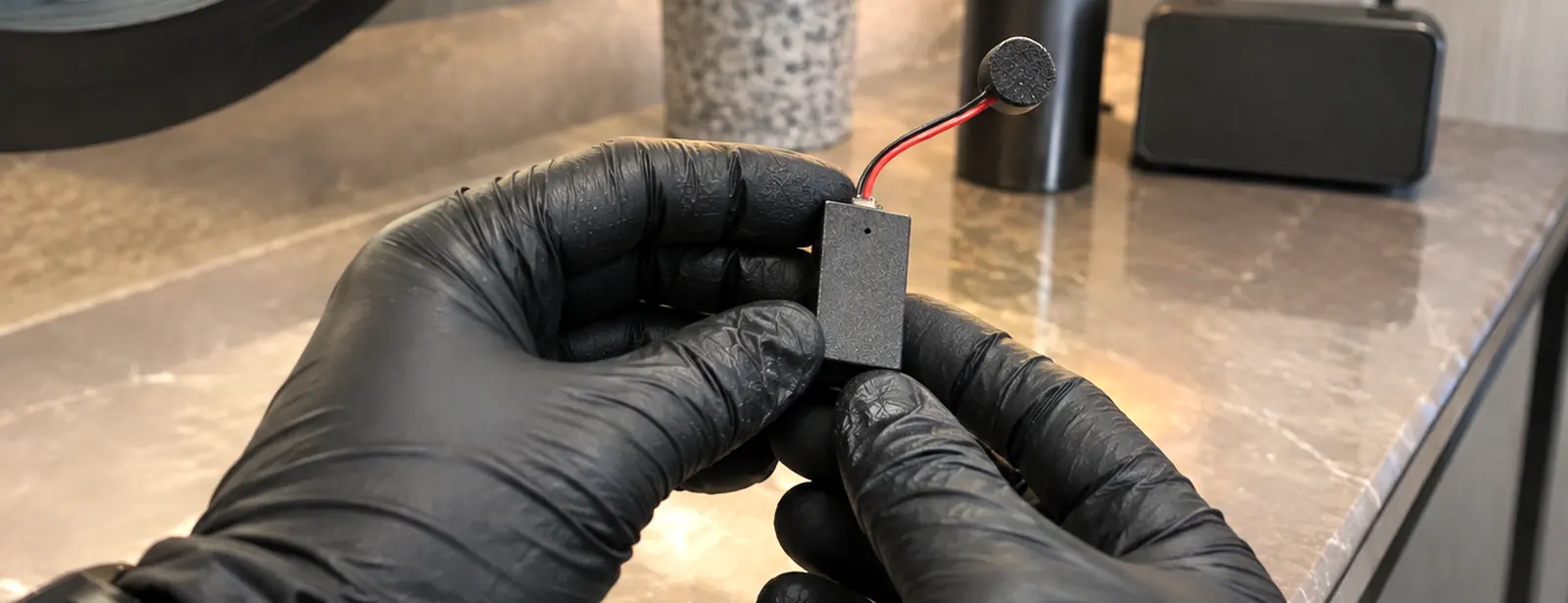
According to the US Department of Justice, a recording device was found on or about 30 September 2026 in an executive conference room at OpenAI’s San Francisco building. Wrapped in toilet paper, it was plugged into a USB port on the back of a TV. Press reports say the find came during a routine sweep, which is a regular check for hidden devices. By the company’s own reckoning, the device had gone in about two days earlier.
A second, similar device turned up days later in a bag the employee had left unattended in a different room. He was then arrested and charged under a US federal law with using, or trying to use, a device to intercept spoken conversations. The charge carries up to five years in prison. Prosecutors stress that it is only an allegation and that he is presumed innocent.
Later in October, the former engineer was indicted, which means formally charged, on a single count. He pleaded not guilty in a San Francisco federal court on 6 November 2026, and his next hearing is set for 17 November 2026.
Who counts as an insider?
As an employee, the man accused in the US case already had access to the company’s building, and many people have the same kind of access to yours.
The UK’s National Protective Security Authority defines an insider as any person who has, or once had, authorised access to or knowledge of an organisation’s people, processes, information, technology and facilities.
In your firm, that covers staff at every level, the contractors and suppliers who come on site, and people who used to work for you. Because the definition is about access, a routine check of a room treats every person who uses it the same way. The check protects those people as well as what they discuss.
Where could a recorder hide in a meeting room?
If your boardroom has a screen on the wall, include the ports and cables behind it in every check of that room. That is where the US device turned up. Give video-call cameras, speakerphones and any spare USB ports the same attention, along with the cables that link them.
Room refits and screen upgrades bring new kit, new cables and new ports into the room, and each one is another place where a small device could sit.
Would network monitoring spot a hidden recorder?
Network monitoring can miss a hidden recorder. Monitoring tools watch the traffic moving across your network, and a recorder that keeps its audio on the device itself may send no traffic at all.
Your IT team’s tools do their own job well. TSCM (technical surveillance counter-measures), the trade name for a professional check for hidden devices, fills the gap between your physical and cyber security. Such a check looks for the electronics themselves, wherever they sit in the room, whether or not they ever connect to your network.
What we look for in your rooms
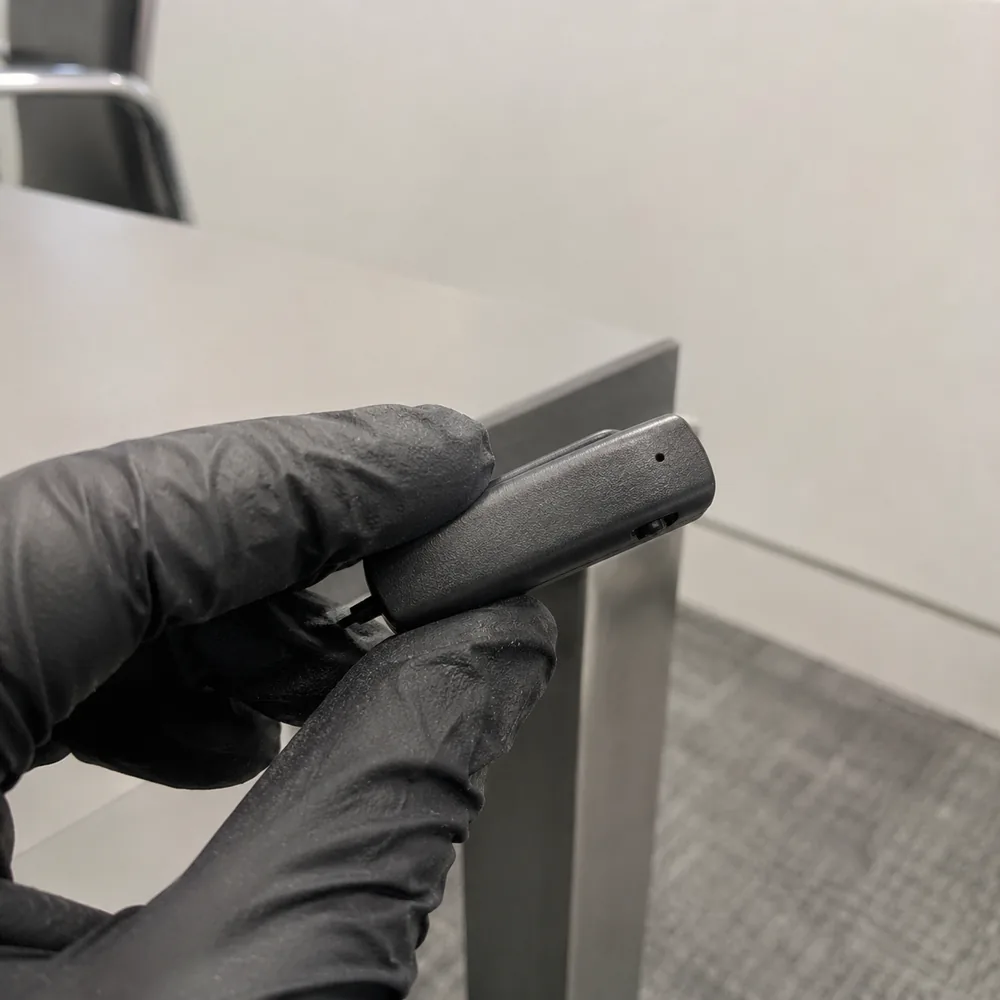
What we check. Our check covers bugs that send out radio signals, hidden cameras and keyloggers, which are small devices or programs that record everything typed on a keyboard. It also covers rogue Wi-Fi points, meaning wireless hotspots set up without your IT team’s knowledge. We check for USB attack devices too, the small gadgets that plug into a USB port and send their own commands to a computer. We rarely find a live device, and weak spots in security turn up on almost every sweep.
Our kit. REI ANDRE and WAM-108t receivers pick up those radio signals. For a recorder that stays silent, our EDD-24T non-linear junction detector finds electronics even when they are switched off. Thermal imaging shows the heat that hidden electronics give off, and a video pole camera, a small camera on an extending pole, lets us see into hard-to-reach spaces. Wireshark and Fing, two network tools, check your network for unknown devices.
Discretion. We can arrive in unmarked vehicles, invoice discreetly and put in place an NDA, which is a confidentiality agreement covering the job. Only trusted operatives do the work. At National Bug Sweeping, we run every job from London and cover the whole UK, and Jack Charman has headed the business since 2020.
Time. A TSCM inspection of a few meeting rooms takes two to four hours, and a large building takes a full day. Evening and weekend visits cost nothing extra, so the check can fit around your board’s diary.
Cost. Prices start from £600 + VAT. Our Office bug sweep is £800 to £1,200 + VAT for a small office, and from £1,200 + VAT for a larger one. For a single high-stakes meeting, our Boardroom bug sweep package costs about £3,000 + VAT. It covers a sweep before the meeting, live monitoring during it and a check afterwards. Travel is priced into every quote, and the final figure depends on your location, the size of the space, the level of threat and how soon you need us.
When do meeting rooms need checking?
If your board meets on a fixed calendar, your checks can follow the same pattern, with each sensitive room checked at set points through the year. We set up Regular TSCM sweeps on a fixed schedule or whenever the risk calls for one. We time them by how sensitive the talks in each room are and how often the room hosts them.
Some moments call for an extra check alongside the schedule, such as after a leak or in the run-up to a deal or a big board meeting. Before a new office or meeting room is first used, we can check it and issue a certificate of clearance.
Between visits, the rooms are in your own team’s hands. The UK National Authority for Counter Eavesdropping highly recommends that you control any space where sensitive conversations take place, such as a boardroom or a meeting room you use often. These four habits help you do that:
- Know who can get in. Review who can enter each room where you hold confidential talks, and who holds the keys and access passes.
- Keep an approved kit list of the screens, cables and ports that belong in each room. Check now and then that what is in the room matches it.
- Take care with ordinary-looking objects carried into the room, especially electrical ones.
- Update the list each time a refit, a new screen or an extra cable goes in.
Questions boards ask us about hidden recorders
Is it known whether the OpenAI hidden recorder captured anything?
No, it is not known whether the device captured anything. According to the US Department of Justice, its contents were encrypted.
What should you do if you find a recording device in your office?
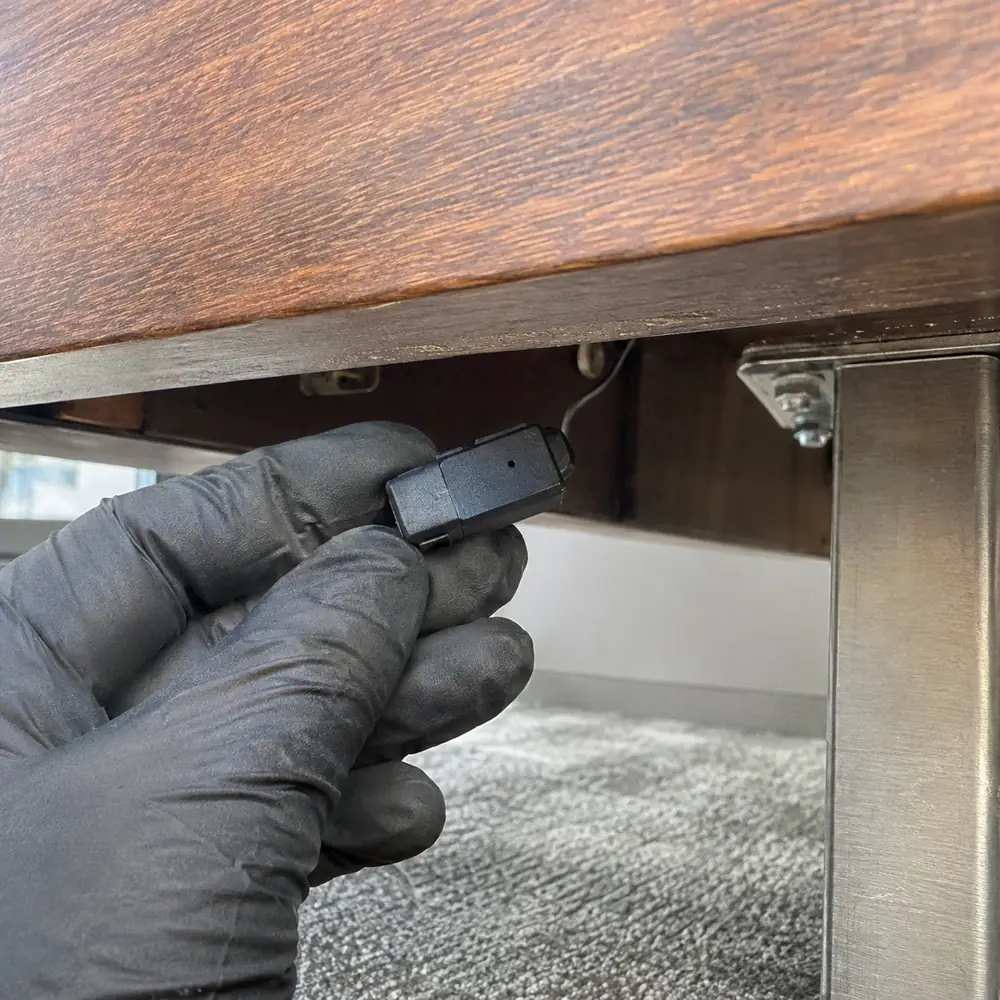
Leave it where it is, do not plug it into a computer, and tell whoever looks after security in your firm straight away. Your security and IT teams need an agreed way to record the find and keep the evidence intact. One find is also a good reason to have your other rooms checked, since the second device in the US case turned up in a different room.
Should you have your rooms checked after a senior employee leaves?
Yes, a senior departure is a sensible point for a check, and we treat the period after someone leaves as a time of higher risk. Anyone who once had authorised access to your building still counts as an insider. A check looks only at the rooms and the kit inside them, so it is fair to everyone.